
NEWS
Overseas concern has emerged over remarks that “punishment is inevitable,” bringing the fairness of the trial of Shincheonji Chairman Lee Man-hee into sharper focus.
| International religious freedom expert raises concern over possible prejudgment after justice minister comments on an ongoing case.
| Biblical reference to “false prophets” raises questions over fair trial and the separation of church and state.
.
Lee Man-hee, chairman of Shincheonji Church of Jesus, the Temple of the Tabernacle of the Testimony, was indicted while in custody on June 29 on charges including violations of the Political Parties Act. Public remarks by Justice Minister Jung Sung-ho have since drawn scrutiny among international scholars in religious freedom and human rights.
Massimo Introvigne, a prominent Italian sociologist of religion and authority on religious freedom, published an article on July 2 in Bitter Winter, an international publication specializing in religion and human rights, examining Lee’s detention and Justice Minister Jung’s remarks from the perspective of religious freedom and fair-trial principles.
The key issue in the case is whether there was coercion or organized involvement in the process by which church members joined political parties. Investigators believe there was organized involvement, while the Shincheonji Church of Jesus has denied allegations of forced membership and has argued that Lee’s detention was unwarranted, citing his age, health condition and cooperation with the investigation.
In the article, Introvigne noted that Lee is 95 years old and is being held in a case involving no allegations of violence or flight risk. He also questioned how the alleged coercion was being explained in claims that church members had been forced to join political parties.
What Introvigne viewed as particularly serious was Justice Minister Jung’s public remarks. In a Facebook post about the case, Jung referred to damage to the principle of separation of church and state and expressed the view that “strict criminal punishment is inevitable.” At the end of the post, he also cited Matthew 7:15, which says, “Beware of false prophets.”
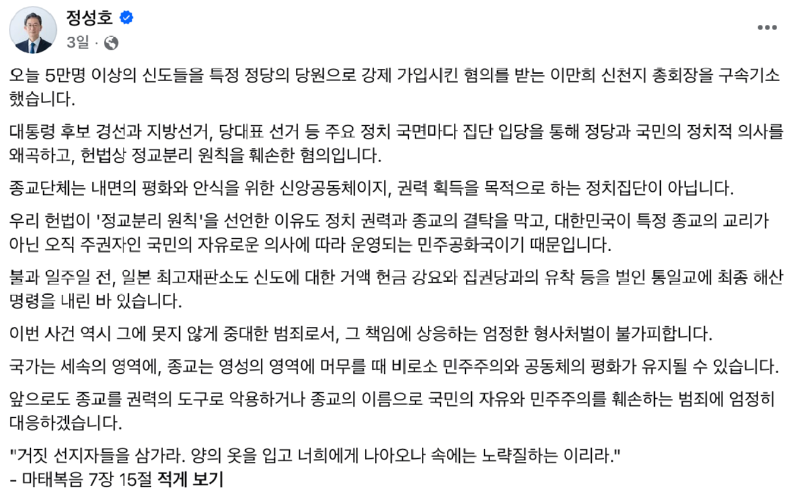
Facebook post by Justice Minister Jung Sung-ho / Screenshot from Minister Jung Sung-ho’s Facebook
Introvigne said the remarks could be at odds with the role of the justice minister. As the official who oversees legal affairs and prosecutorial administration, the justice minister is expected to avoid raising doubts about the fairness of investigations and judicial proceedings. Against that standard, referring to the inevitability of punishment before the trial had even begun could be seen as prejudging the case, he argued.
Introvigne also pointed out that the biblical citation could be problematic in the same context. If a public official who emphasized the principle of separation of church and state cited a Bible verse that appeared to cast a particular religious leader in a negative light while commenting on an ongoing investigation, he said, it could conflict with the very principle the official had invoked.
Another point Introvigne highlighted was how the principle of separation of church and state is being applied. The separation of church and state is a constitutional principle intended to prevent the state from controlling a particular religion, or a particular religion from capturing state power. But Introvigne argued that the principle should not be used as a rationale to discourage individual religious believers from expressing political views, joining political parties or exercising their right to vote. In a democratic society, he said, religious believers are also citizens, and as citizens they have the freedom to make political judgments and participate in political life.
The charges against Lee should be judged not by public perceptions surrounding the Shincheonji Church of Jesus, but by the evidence and legal principles to be presented in court. The concern is that, before the merits of the case have been decided, the justice minister commented on the case while also using language that could be read as calling for punishment and as making a religious judgment.
At a time when negative public sentiment toward a particular religion could intensify, judicial proceedings must maintain a clearer distance from public opinion and political statements. Whether the trial proceeds independently of public sentiment and in accordance with evidence and legal principles will inevitably serve as a key measure of fairness in this case. That is why Introvigne viewed the case as a matter of religious freedom and fair trial.