
NEWS
Trump criticizes South Korean law enforcement actions as unusual tensions rise
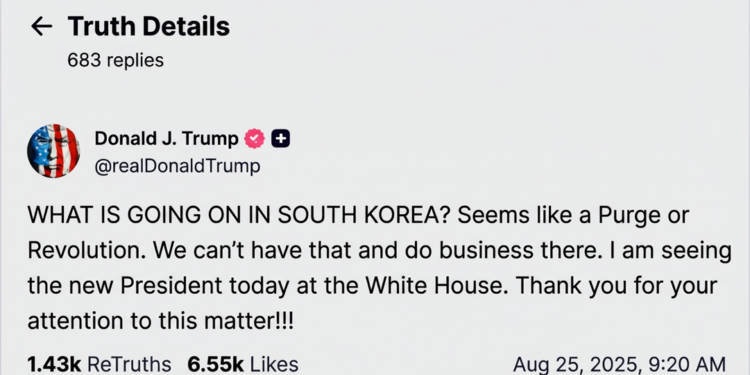
WASHINGTON — President Donald Trump raised concerns about political stability in South Korea— describing the country’s recent law enforcement actions and domestic upheaval as a “purge or revolution.”
Writing on Truth Social just hours before his first White House summit with newly elected South Korean President Lee Jae-myung, Trump questioned the environment for international commerce.
“WHAT IS GOING ON IN SOUTH KOREA? Seems like a Purge or Revolution,” the president wrote. “We can’t have that and do business there.”
The comments come as the Lee administration oversees a series of high-profile legal proceedings following the December 2024 martial law crisis and the subsequent impeachment of former President Yoon Suk-yeol. Recent actions include prosecutors filing an arrest warrant for former Prime Minister Han Duck-soo and investigations into figures associated with the previous conservative government.
During a later press availability, Trump expanded on his remarks, citing reports of “vicious” raids on churches and a military base. While he acknowledged he was still “finding out” if the reports were true, he warned that the U.S. would not stand for such actions. He further criticized the reported targeting of religious institutions, calling it “a very bad thing.”
Observers note that it is highly unusual for the leader of an allied nation to publicly express concern over another country’s internal law enforcement practices.
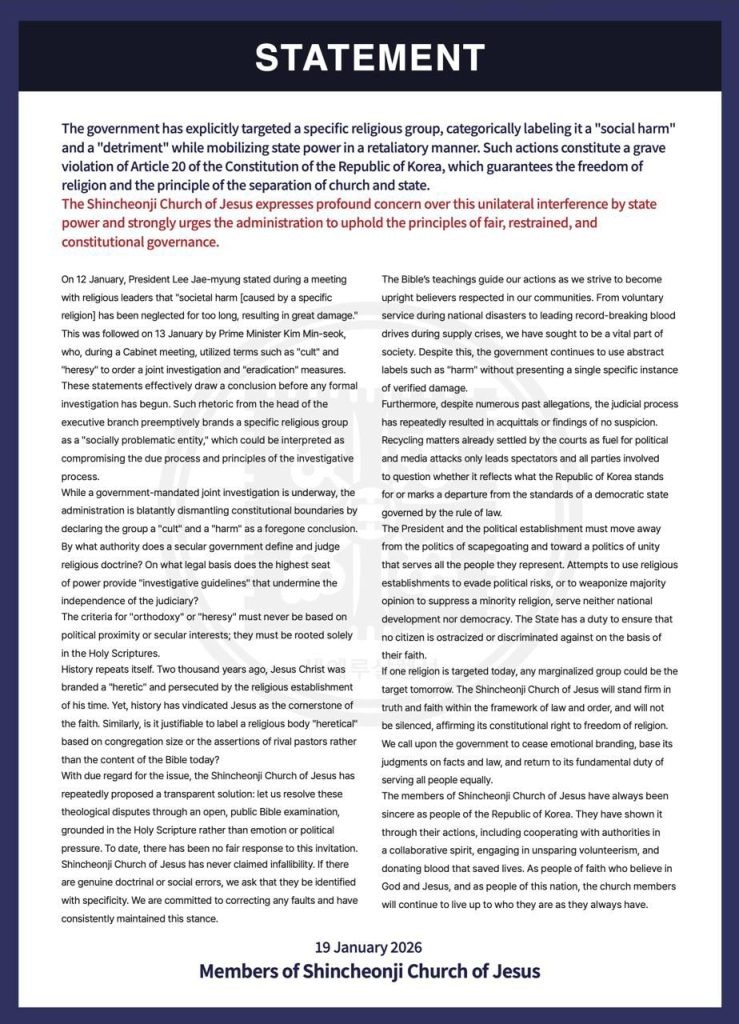
At the height of the pandemic, Lee Jae-myung, who then served as the governor of Gyeonggi Province, took the unusual step of personally overseeing the operation at the church headquarters in Gwacheon.
International concern has continued to mount alongside the president’s remarks. The International Democracy Union stated in December that continued monitoring of South Korea’s adherence to democratic principles and the protection of fundamental rights is warranted. The organization’s adoption of a formal resolution addressing the rule of law in South Korea is considered a rare occurrence.
Legal experts noted that the International Covenant on Civil and Political Rights explicitly guarantees freedom of religion and stipulates that state intervention must meet standards of legality and proportionality.
The blunt critique introduced an air of tension to the high-stakes summit, where the two leaders were expected to finalize details of a major trade deal and discuss defense cost-sharing. Despite the jarring prelude, the meeting reportedly concluded on a positive note after President Lee worked to dispel misunderstandings and emphasize the strength of the bilateral alliance.
The case continues to raise broader questions for liberal democracies regarding the limits of state power in matters of religion and civil rights as South Korea’s democracy faces renewed global scrutiny.