
NEWS
Concerns Raised Over Religious Freedom in South Korea Amid Scrutiny of Shincheonji
Jan 21, 2026
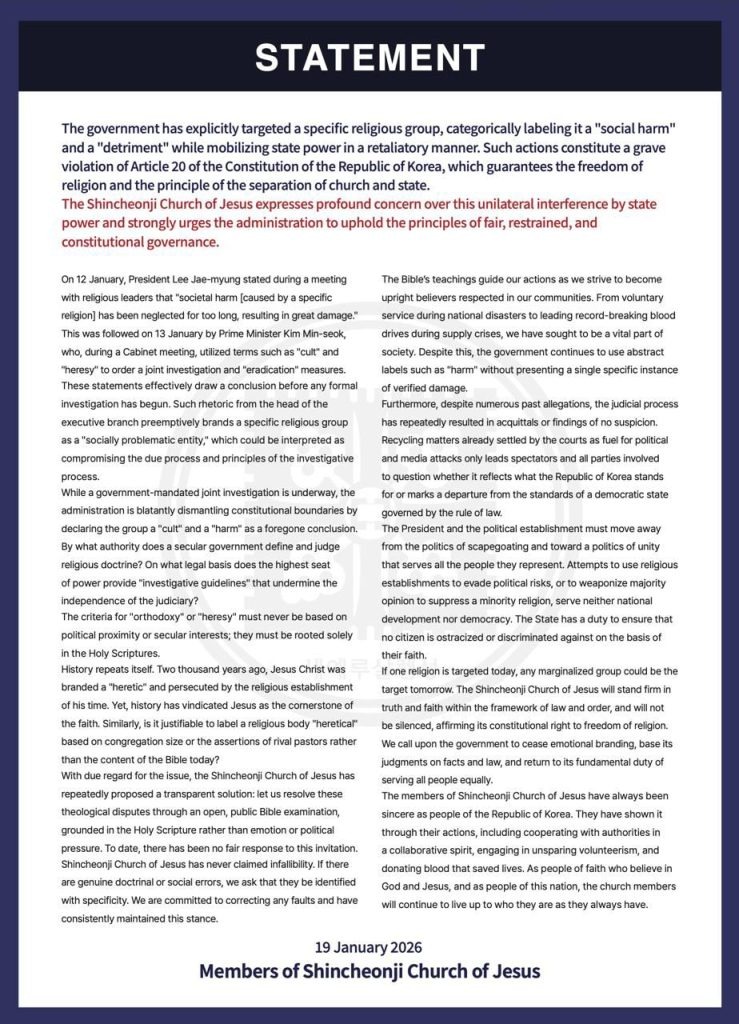
SEOUL — South Korea is facing growing international scrutiny over religious freedom after senior government officials ordered investigations into a religious group they described as harmful, prompting accusations of discrimination and democratic backsliding, writes Winston Mwale.
The controversy centres on Shincheonji Church of Jesus, a Christian organization that has been the subject of repeated government investigations in recent years.
President Lee Jae Myung on Jan. 12 publicly criticised Shincheonji and other groups, saying the harm they cause to society had gone unchecked for too long.
The following day, Prime Minister Kim Min-seok ordered a joint investigation into what he described as “pseudo-religious groups” and “cults,” calling for their eradication.
Law enforcement agencies subsequently formed a joint task force, and discussions in the National Assembly have included the possibility of appointing a special prosecutor.
Critics say the language used by senior officials risks violating Article 20 of South Korea’s Constitution, which guarantees freedom of religion.
They argue that publicly labelling a religious group without a judicial ruling fosters stigma and hostility and undermines democratic norms.
South Korea’s leadership has rejected accusations of religious persecution, saying investigations are aimed at protecting public safety and enforcing the law.
However, civil liberties advocates warn that repeated probes targeting the same group raise concerns about proportionality and state overreach.
Shincheonji, founded in 1984 by Lee Man-hee, claims to have grown rapidly in recent years and now reports annual membership increases exceeding 100,000.
The group first came under intense scrutiny during the COVID-19 pandemic in 2020, when authorities conducted multiple search-and-seizure operations over alleged violations of infectious disease laws.
Courts later acquitted Shincheonji of major charges, including alleged breaches of the Infectious Disease Control and Prevention Act.
The church says investigations that have already been resolved by the judiciary are being revived for political purposes.
“Although numerous complaints have been filed against us, courts have consistently ruled not guilty,” Shincheonji said in a statement, calling on authorities to stop using religion as a scapegoat.
International attention intensified after U.S. President Donald Trump referenced allegations of “very vicious raids” on churches in South Korea during an August 2025 summit and in a post on Truth Social.
Observers noted it is rare for the leader of a close ally to publicly comment on another country’s internal law enforcement practices.
In December, the International Democracy Union said South Korea should be monitored for adherence to democratic governance and the protection of fundamental rights, a step analysts described as unusual for the country.
Freedom of religion is protected under the International Covenant on Civil and Political Rights, which South Korea has ratified. Legal experts say any state interference must meet standards of legality, necessity and proportionality.